From Outdated Site to Advocacy Hub

How a redesign empowered Tocker Foundation to support rural libraries
Tocker Foundation logo on top of a screened image of remodeled library shelves with natural light.

The Challenge

Since 1992, the Tocker Foundation has profoundly impacted hundreds of rural libraries across Texas through grants and advocacy. By 2017, we partnered with the Foundation to launch their first fully responsive website, which grew into a platform for visibility, resource-sharing, and broadband advocacy.

But as censorship threats escalated nationwide, libraries needed Tocker’s website to do more. New resources had been added piecemeal over the years, and outdated software made it harder to keep information consistent and accessible. The site no longer reflected the clarity or authority the Foundation needed to champion intellectual freedom.

The Solution

My goal was to transform the website into a clear, accessible hub for resources and advocacy.

Services Provided

Content Strategy & Editing
Web Design

I’ve been working with Janel for years, and it’s always a pleasure. Recently, we were talking about adding a new resource to our website—something totally different from what we’ve done before—and she asked questions and made suggestions I never would’ve thought of.

That’s one of the main reasons I love working with her: she sees things differently, and it always helps move things forward.

headshot of Karin Gerstenhaber with chin-length wavy hair and bright green collared shirt.

Karen Gerstenhaber

Tocker Foundation
Desktop and mobile views of the Tocker Foundation homepage.

Information Architecture

I conducted a full content audit, restructuring the site to make navigation intuitive. Redundant pages were merged, clutter was removed, and every page was optimized with sequential headings, meta descriptions, and clear calls to action.

Building for Users and Growth

Simplifying the site wasn’t just about cleaning up old content. It was about making resources easier for everyone to use, especially visitors who aren’t as tech-savvy. That stronger foundation also made it easier to grow the site over time. For instance, when the Foundation wanted to add a step-by-step guide to its detailed grant application process, we could design and launch it quickly without adding complexity.
Tocker grant application guide with floating sidebar.

Blog Redesign

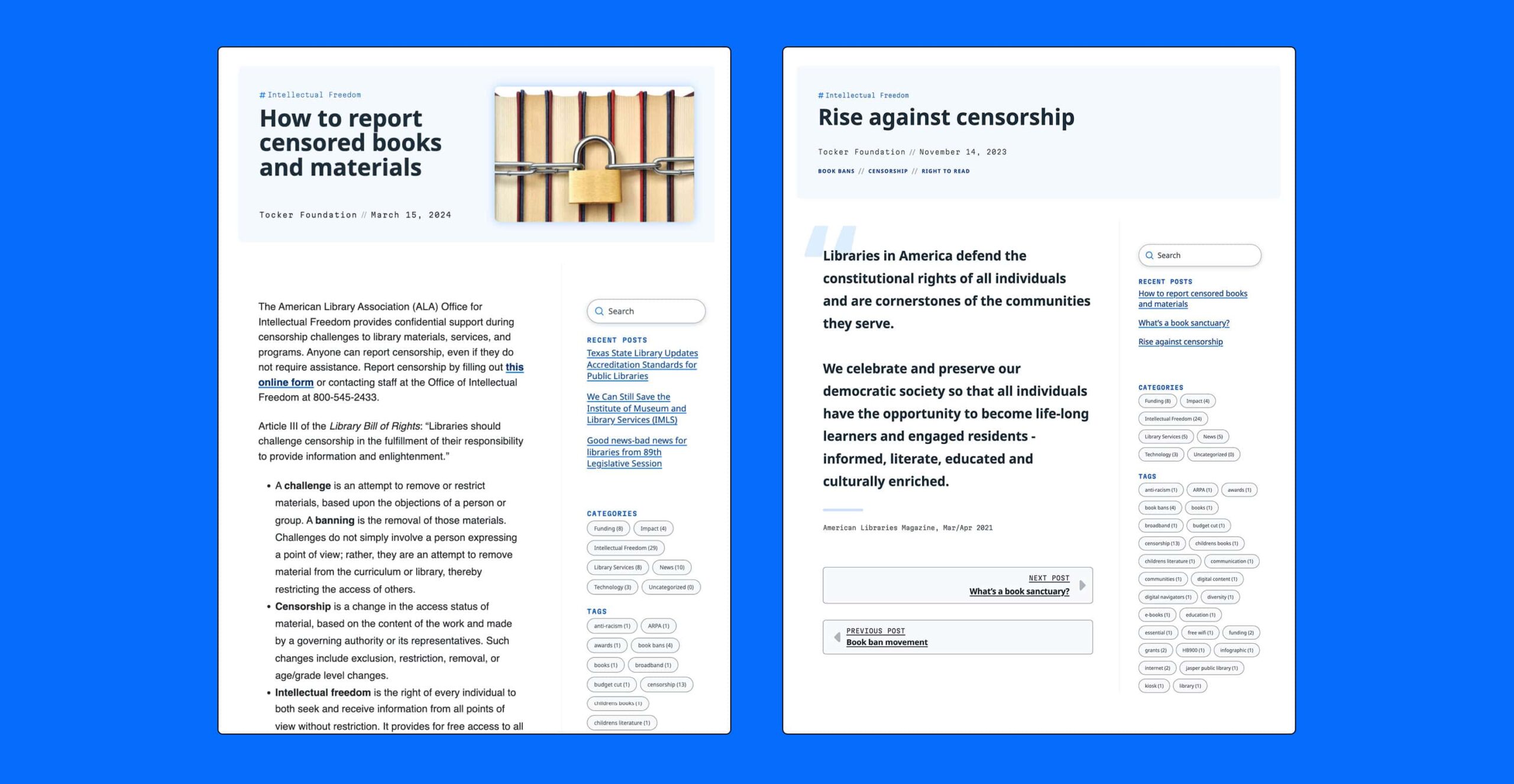
The blog became a central resource. Categories and tags were reorganized for discoverability, post titles were shortened for clarity, and images were standardized for better social sharing. We introduced custom layouts: one for standard posts and a distinctive design for quotes, giving Tocker flexibility and consistency.
Image
Image

Accessibility

I used WCAG standards as a guide, but my focus was on making the site genuinely easier to use. Clear typefaces, simple keyboard navigation, and ARIA labels help people with low vision or screen readers, while lightweight pages keep things quick for anyone with slow internet.

Visual Design

Simple one- and two-column layouts ensure consistency across mobile and desktop. Calls to action and buttons use the Foundation’s brightest blue, making them stand out without overwhelming the content.
Image
Image

The Results

Tocker now has a streamlined, user-friendly website that makes it easier for libraries to access resources.
  • The improved blog structure strengthens advocacy efforts by making timely updates and thought leadership easier to find and share.
  • Accessibility improvements ensure inclusivity, aligning with the Foundation’s mission to serve communities of all sizes.
  • Faster site performance supports rural communities with limited broadband access.
Checkout the next case study.

Interested in working together?

Grab a 15-minute call, no strings, to see if we're a good match!